North Texas FWC Organizing Committee
FIFA World Cup Dallas - Interactive Map Experience
THE CLIENT
North Texas FIFA World Cup Organizing Committee, tasked with hosting global soccer fans for the historic FIFA World Cup tournament in North Texas, managed massive international foot traffic across the sprawling Dallas-Fort Worth (DFW) metroplex during World Cup 2026. In addition to leading the FIFA Fan Festival, the committee curated the reliable digital infrastructure that welcomed fans, highlighted corporate sponsors, and drove measurable economic impact toward local businesses.
THE CHALLENGE
With millions of international visitors descending upon North Texas, World Cup Dallas faced a monumental logistical challenge: how to seamlessly guide a global audience through a highly decentralized, multi-city metroplex.
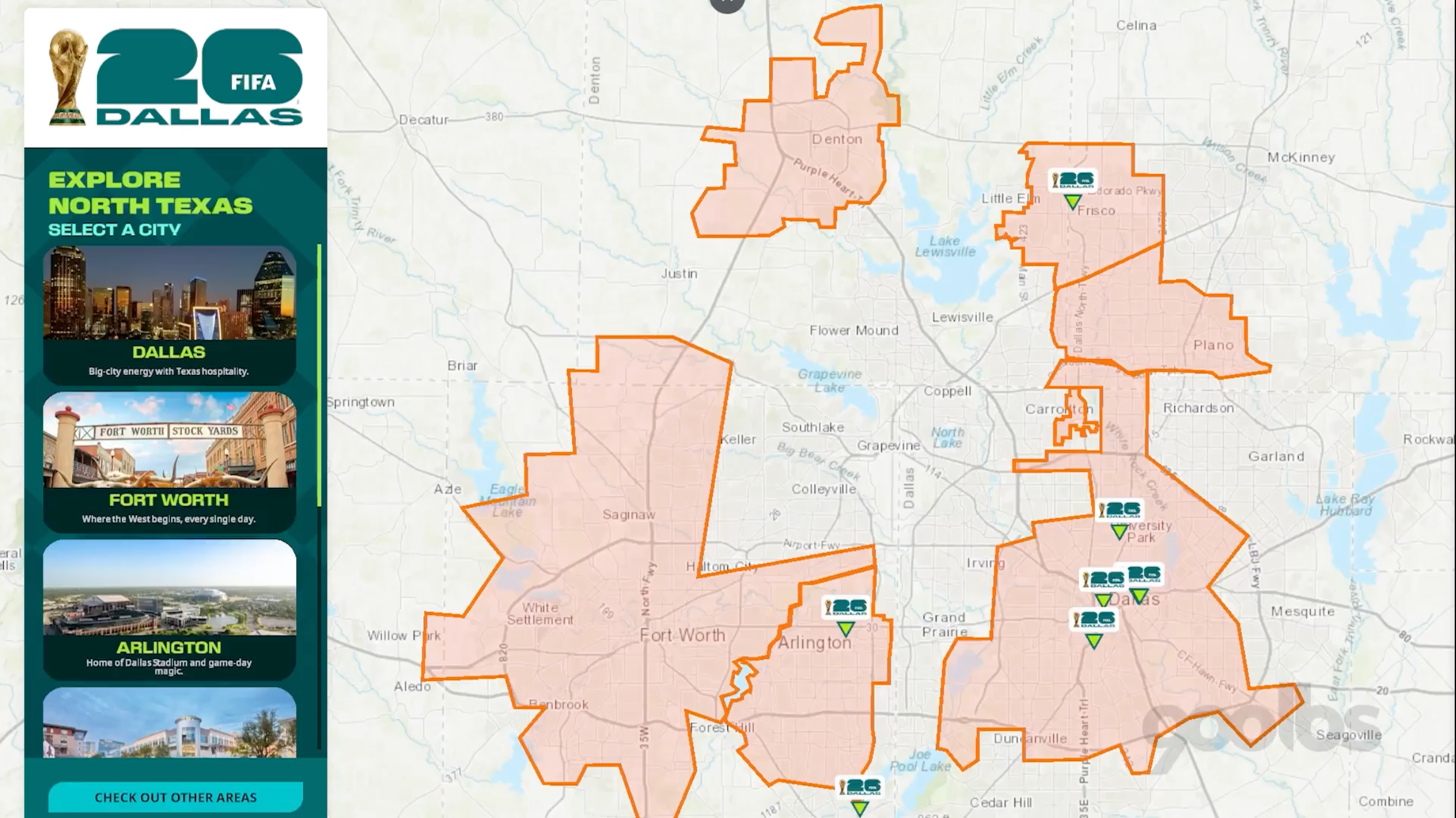
The committee required an intuitive, visitor-friendly map experience that could highlight thousands of points of interest (POIs) across several sprawling municipalities and cultural neighborhoods, including major city centers like Dallas, Fort Worth, and Arlington, as well as critical hubs like Frisco, Plano, Addison, Irving, and Denton. Crucially, the experience needed to be highly stable and accessible instantly on any device—without the barrier of downloading a native app.
This was a quick-turn project, and the constrained timeline left little room for technical risk. The platform had to be built, optimized and bulk-ingested with massive amounts of city data. The experience needed to launch a week prior to the first match in Dallas Fort Worth in order for international guests to engage with it.
THE SOLUTION
900lbs designed and developed a custom, high-performance interactive map experience engineered specifically for speed, stability, and visual immersion.
Built utilizing the Unity Engine and compiled into highly optimized WebGL for web browsers, 900lbs bypassed the traditional technical risks of standard APIs and live content management systems.
Instead, the Team utilized a robust, hard-coded data pipeline that streamlined the bulk JSON ingestion of all data records curated by local city entities.
1. Immersive Art Direction & Brand Alignment
- 900lbs aligned the experience's user interface directly with official FIFA World Cup branding, creating a premium aesthetic. From the moment users launched the experience, they were greeted with a dynamic loading screen prominently displaying the North Texas FWC Organizing Committee sponsorship.
- The visual hierarchy utilized a sophisticated color palette—integrating custom brand orange silhouettes for accurate city and neighborhood outlines—ensuring immediate contrast and aesthetic harmony.
2. Deep-Dive Regional Exploration
- The application introduced a manual, city-focused exploration model. Cities were intelligently sorted by population size (with Dallas and Fort Worth properly spelled and prioritized).
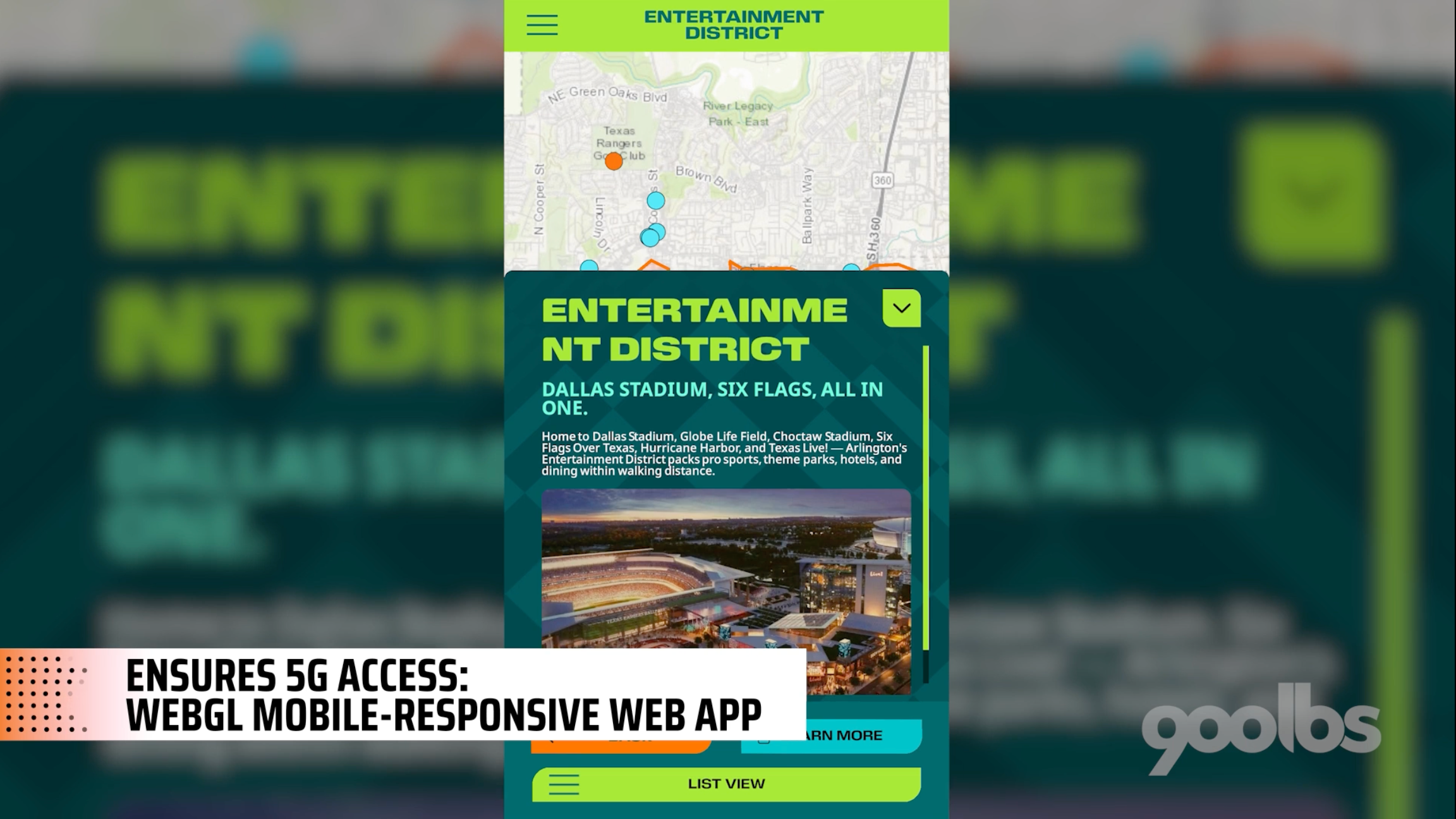
- Within major epicenters like Dallas, Fort Worth, and Arlington, users could zoom into specific culture-rich "Neighborhood Zones"—such as the Dallas Arts District, Deep Ellum, the Fort Worth Stockyards, and the Arlington Entertainment District.
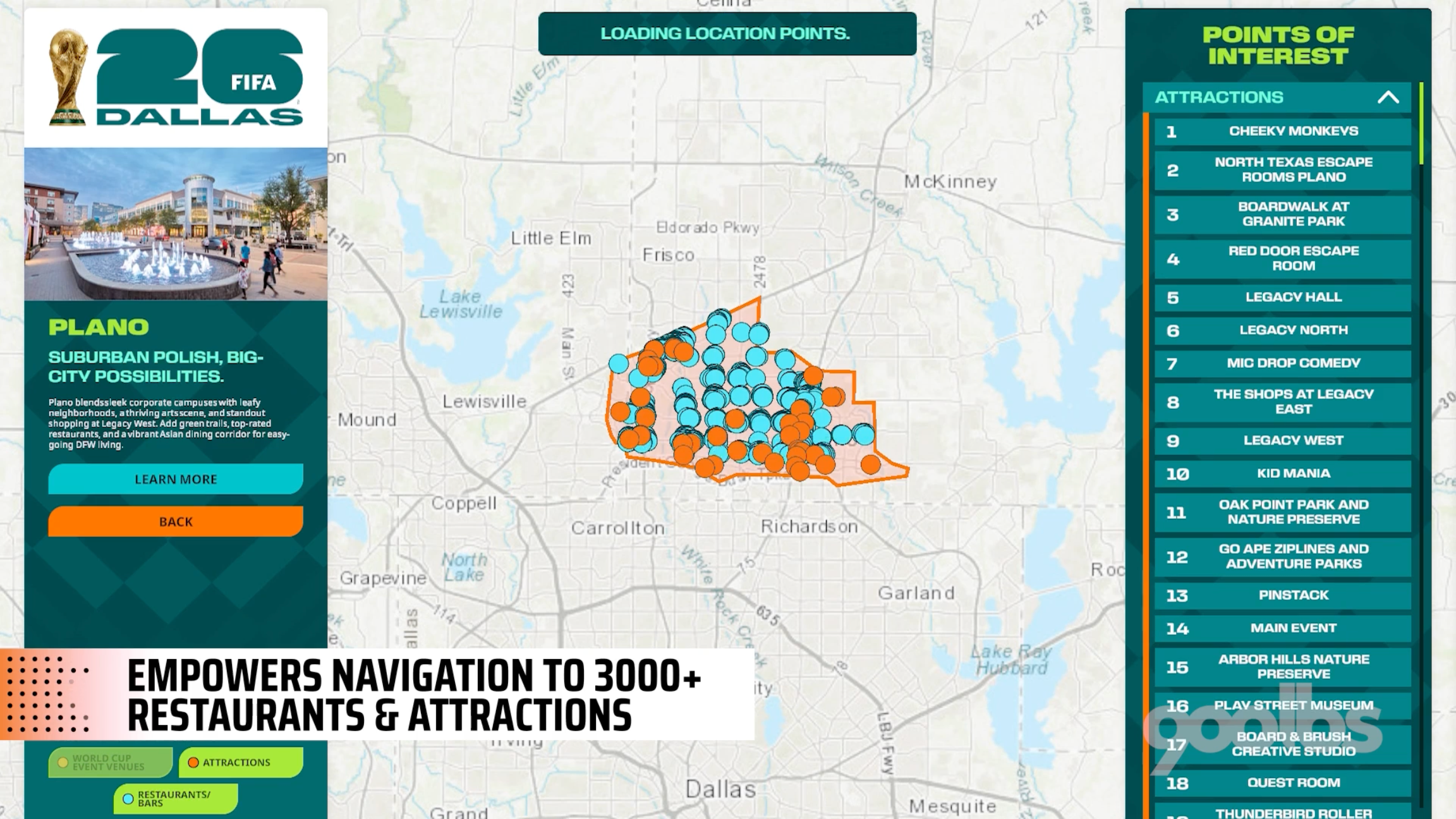
- Each neighborhood features guided tours packed with curated descriptions, taglines, fun facts, and a vivid 16:9 layout.
3. Frictionless Navigation & Smart Filtering
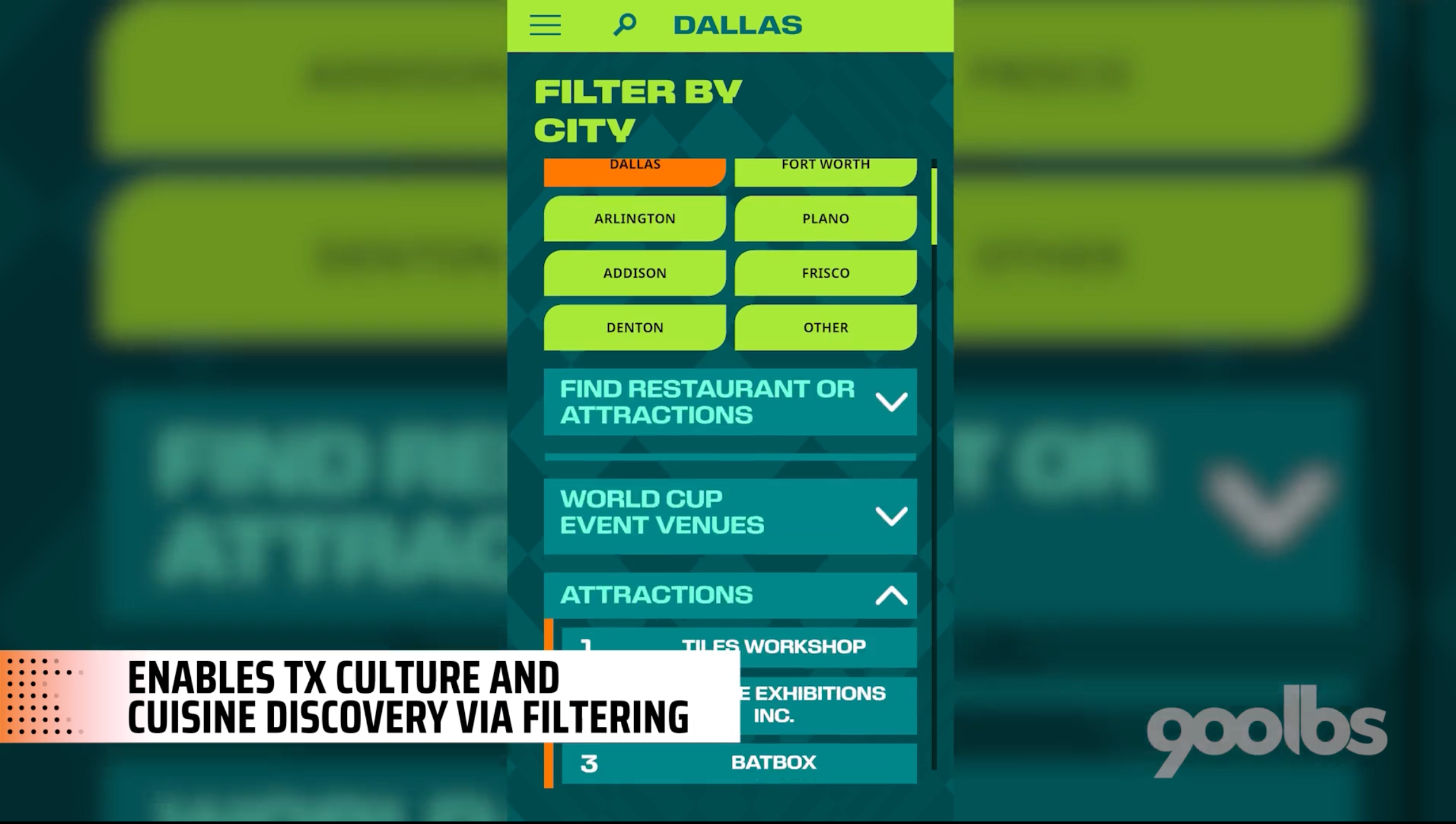
- To ensure maximum ease of use on crowded 5G networks, 900lbs streamlined the user journey down to three distinct, color-coded filters:
- World Cup Event Venues (Yellow): Direct paths to the matches and official zones like the FIFA Fan Fest.
- Restaurants & Bars (Orange): Quick sorting of local culinary hotspots categorized across 25 distinct cuisine types.
- Attractions (Blue): City landmarks and cultural points of interest.
- Rather than relying on resource-heavy dynamic mapping, the app locked zoom levels to a fixed, highly responsive overview. When visitors selected a destination, the UI surface provided one-click deep links that seamlessly handed off routing to native Google Maps or Apple Maps depending on the user's mobile OS (iOS/Android) or desktop browser.
4. Live Services & Bulletproof Architecture
- To guarantee absolute uptime during the six-week tournament window, 900lbs deployed the web experience via Cloudflare hosting.
- Images were dynamically scaled based on network conditions to prevent lag, while the team provided active Live Services support throughout the tournament to monitor server traffic, manage hotfixes, and handle browser edge cases.
- Detailed view analytics were tracked transparently via a dedicated Google Analytics ID to capture real-time visitor behaviors per city and venue.
5. AI-Supported Data Generation, Image Processing, and Backend Mgmt
- DFW’s local Cities’ Visitor Bureaus each contributed data, including location names, addresses, websites, descriptions, and images. However, the 3000+ data records needed many other backend metadata tags, including latitude and longitude, cuisine type, north-south location ranking, description summaries, URL corrections for HTTPS, and neighborhood locations.
- We selectively vetted and employed Excel automations, Geocoding tools, LLM tools to dramatically speed up production time and reliability of metadata for locations and neighborhoods.
- Some automation tools were employed to allow batch editing/cropping of images to optimize for different sizes and ensure WebGL loading time stayed low.
- Lastly, we utilized Git, AI-enabled IDEs, and Python data scripting to aggregate all data into a formatted, version controlled JSON file that could quickly load into the build at run-time.
- This sped up iterative development time without adding a complex database stack to our backend, since this was largely a static dataset that wouldn’t change over time.
THE RESULTS
Launched Ahead of Schedule
The entire interactive map experience was successfully developed, optimized, and deployed by mid-June, going live well before the very first Dallas FIFA match kicked off.
Seamless Global Accessibility
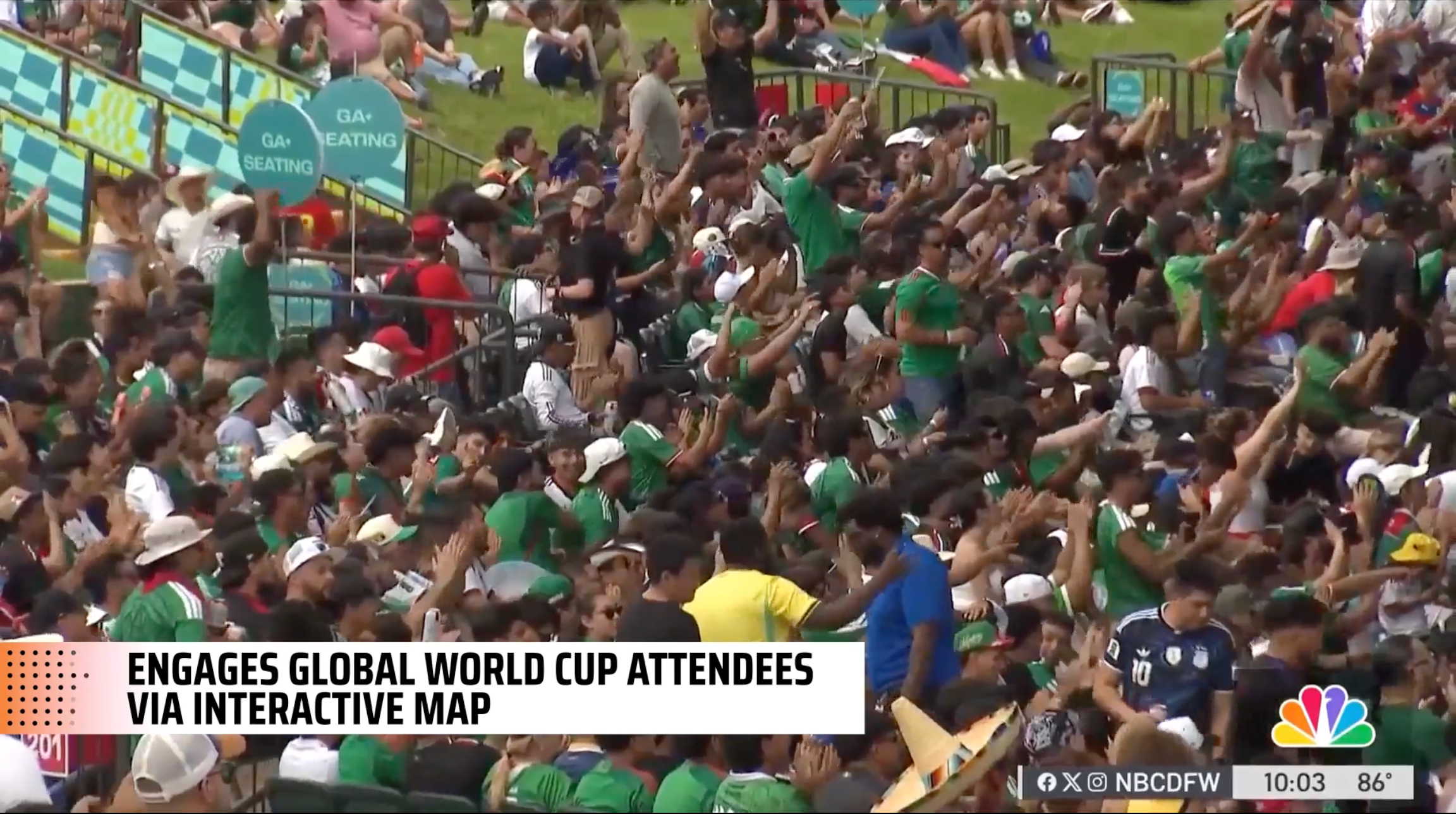
By engineering the experience as a Progressive WebApp via Unity WebGL rather than forcing a native app store download, 900lbs eliminated onboarding friction. Global visitors easily accessed the map on busy stadium 5G networks and desktop environments alike, while the physical event center kiosks maintained consistent uptime.
Massive Regional Footprint
The application successfully mapped 8 major World Cup venues and powered the discovery of more than 3,000 neighborhood zones, local points of interest, and regional restaurants.
Tangible Economic Development
By giving international soccer fans an interactive, filterable guide to explore the culture of DFW, the project successfully fulfilled the World Cup Committee's economic development goals—funneling global tourism dollars directly into local North Texas neighborhoods and hospitality businesses.